
A Stronger Core with Updated Mobile SDKs and Enhanced Transparency

This update focuses on giving teams more visibility, flexibility, and reach across their data pipelines. You’ll find meaningful upgrades to core infrastructure alongside new integrations for activation, attribution, and analytics.
Revamped iOS & React Native Mobile SDKs
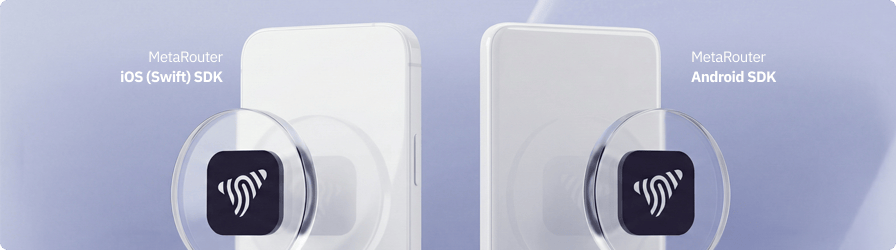
MetaRouter now fully supports mobile analytics data tracking with our own iOS and React Native SDKs. These enable you to to track events originating from your mobile app events. We are developing a mobile app tracking roadmap- please let your Customer Success Manager know if you’d like to see certain features included within these SDKs. MetaRouter iOS (Swift) SDK MetaRouter Android SDK
Event Metrics API
We’ve been striving to improve observability into the MetaRouter’s infrastructure performance. The Event Metrics API enables your organization to programmatically retrieve all of the event metrics available in the MetaRouter UI and insert them into your own observability database. Please reach out to your Customer Success Manager if you’d like to enable the metrics API for your organization. MetaRouter Event Metrics API
Cross-Domain Scalability Update
MetaRouter’s cross-domain tracking capability enables a single, persistent anonymous identifier to be maintained across multiple top-level domains- unlocking a deep understanding of user behavior patterns across all of your owned domains. This update improves the cross-domain feature’s ability to scale across hundreds- or even thousands- of domains to ensure the world’s largest enterprises can maintain a singular view of users across all of their domains.
Transparency Consent Framework (TCF) v2.2 Support
The Transparency & Consent Framework provides a straight-forward means for users in the European Union to manage their consent preferences, particularly within the programmatic advertising ecosystem. MetaRouter now supports the handling of these signals to determine whether user event data should be collected and reach specific AdTech destinations. MetaRouter Transparency & Consent Framework v2.2
Pipeline Transforms & Filters
Pipeline Transformations & Filters provide a data transformation layer above the playbook level- meaning that any data passing through a pipeline can be transformed prior to being consumed by a playbook for further transformation and delivery to a destination. Pipeline Transforms provide a significant degree of flexibility that help MetaRouter customers achieve meet use cases such as data normalization, sensitive data filtering, conditional event duplication and splitting for Retail Media Networks, and more.
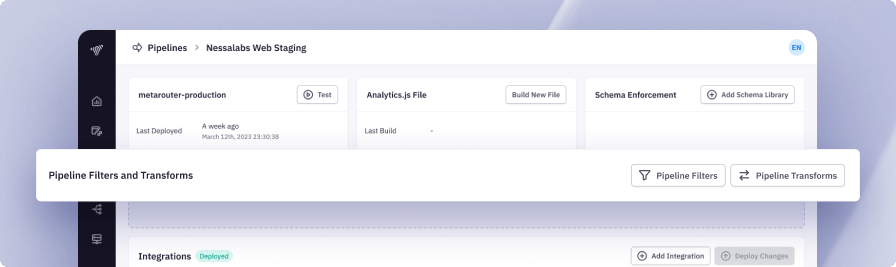
These pipeline-level transformations and filters can now be viewed in the MetaRouter UI, and soon will be fully managed from the UI as well. For now, you can implement Pipeline Transforms and Filters from the MetaRouter CLI. Reach out to your support team for more information regarding your organization’s strategy for event transformation and filtering.
Ability to Pause Integrations
MetaRouter users can now pause integrations, temporarily preventing the flow of data to a specific destination until the integration is re-activated. Pausing and re-activating an integration can be done through the Pipeline Overview page in the MetaRouter UI.
New Integrations
We’ve added several new integrations to help you activate events across DSPs, mobile attribution platforms, and analytics tools. Each integration is built for server-side delivery with support for deduplication, identity matching, and flexible event mapping.
Unlock server-side conversion tracking with our new The Trade Desk integration. Send key e-commerce events (e.g., purchases, add-to-cart, views) directly to The Trade Desk and leverage first-party IDs like ttd_id for improved attribution. Documentation
Bridge the gap between anonymous devices and known users using the Kochava IdentityLink™ integration. Link device IDs with user identifiers to enable cross-device recognition, targeting, and suppression logic for iOS and Android. Documentation
Leverage the Perion integration to connect your event data with Perion’s media activation and measurement partners. Activate your customer insights across Perion’s advertising channels and campaigns. Documentation
Send server-to-server conversion events directly into Amazon DSP with the new CAPI destination. Support hashed user IDs, deduplication, and custom event mappings to ensure accurate matching and measurement across Amazon’s programmatic inventory. Documentation
Bring your event stream into LinkedIn Ads for conversions and audience targeting. Leverage your first-party and server-side data to unlock insight across professional segments in LinkedIn Ads. Documentation
Drive conversions and enrich attribution with the Rakuten integration. Route your event data to Rakuten’s conversion network to track performance, measurement, and cross-publisher reach. Documentation
This integration sends first-party conversion events to Microsoft Ads using the Conversion API. It enables server-side event delivery for improved consistency and attribution in Microsoft Ads reporting. Documentation
This integration sends server-side event batches via the Bulk Data Insertion API to Adobe Analytics, supporting full-funnel web and mobile data ingestion with standard commerce event mapping and deduplication. Documentation
Identity Syncs
This release adds new server-side syncs with Amperity and Perion, making it easier to enrich events with profile attributes and persistent identifiers. These syncs store data as first-party values, improving personalization, attribution, and downstream activation.
Supercharge your customer profiles with the Amperity Profile Sync integration. Fetch enriched attributes from Amperity and inject them into your event stream for personalization, targeting, and analytics. Documentation
The Perion Sync captures unique Perion user and session identifiers from a first-party request. These IDs are stored and used in downstream events to help match users and improve attribution within Perion’s platform. Documentation
